

Short answer: In the ordinary California divorce or legal-separation process, each required party shares financial information with the other party. The preliminary packet commonly includes FL‑140, FL‑150, and either FL‑142 or FL‑160, plus supporting records. The packet is exchanged—not simply filed as one public court submission. FL‑141 is then filed to tell the court the disclosure service occurred.
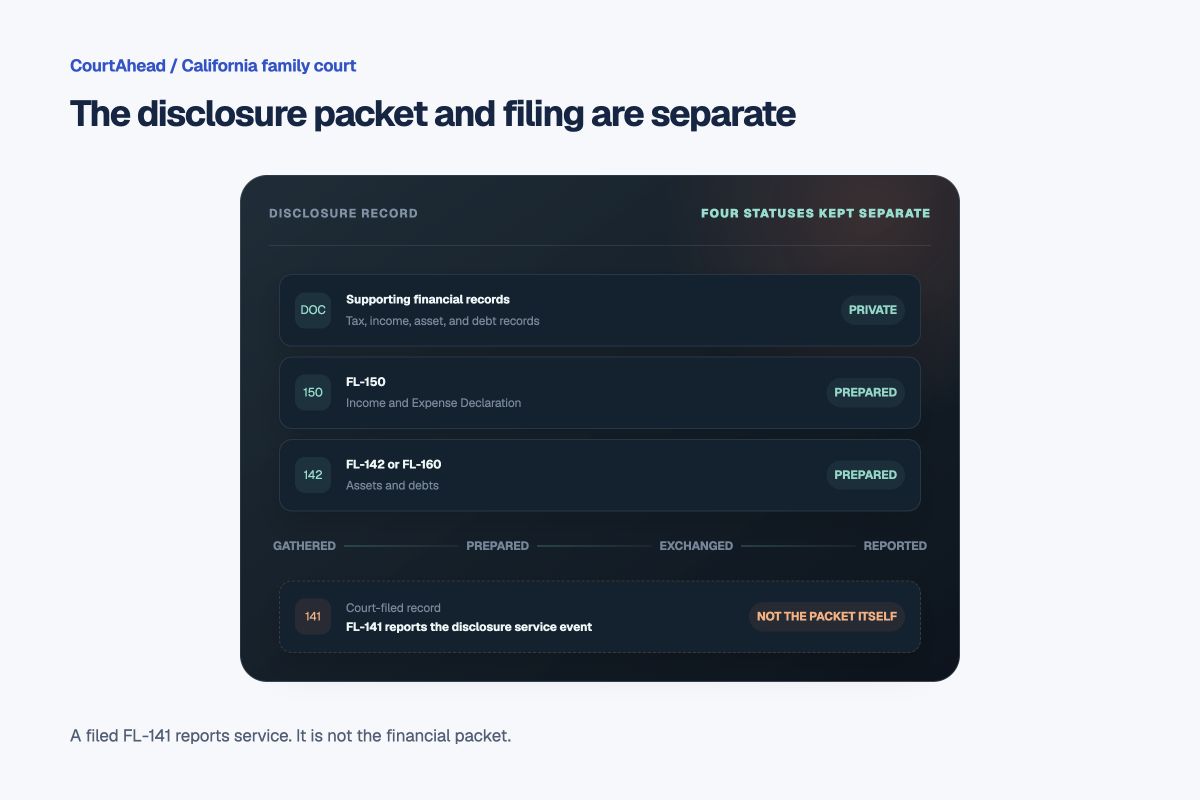
California Courts says financial disclosure is required in every divorce or legal separation and identifies separate preliminary deadlines for the petitioner and a respondent who filed a Response.
Read the official financial-disclosure overview ↗What is in a California preliminary disclosure packet?
California Courts lists three form groups for the ordinary preliminary exchange:
The signed cover document describing the disclosure being provided.
Employment, income, deductions, assets, household expenses and other financial facts.
The property-and-debt record used for the disclosure path.
Tax, income, account, title, debt, and other records that apply.
FL‑141 is related but serves a different role: it tells the court that the declaration of disclosure and income-and-expense information were served. Do not treat FL‑141 as a substitute for the underlying packet.
When are preliminary disclosures due?
California Courts states that the petitioner ordinarily completes preliminary disclosures within 60 days after filing the Petition, and a respondent who filed a Response ordinarily completes them within 60 days after filing the Response. A respondent participating in a default-with-agreement path also has disclosure obligations. California Courts: preliminary disclosures.
What records should you gather?
California Courts’ gathering guide starts with:
- tax returns from the last two years;
- proof of income for the past two months;
- documents showing what you own and owe; and
- as applicable, mortgage, bank, vehicle-title, credit-card and retirement-account records.
Keep complete original copies private before creating redacted or annotated working copies. Each number typed on a form should remain connected to the record, date range, and calculation used to produce it.
List the packet before calling it complete.
Track disclosure forms and supporting records locally in your browser, with “have,” “find,” and “verify” kept separate.
What gets exchanged, and what gets filed?
For the ordinary divorce disclosure track, California Courts says the financial documents are shared with the other party rather than filed with the court. FL‑141 is filed to report that the disclosure service occurred.
But FL‑150 can also belong to a different event. When support or attorney’s fees are requested through an FL‑300 or answered through an FL‑320, a current FL‑150 may be filed with the court and served as part of that hearing packet. The form number alone does not tell you which path occurred.
FL‑140, FL‑150, FL‑142 or FL‑160, and applicable supporting records are exchanged. FL‑141 reports service to the court.
A current FL‑150 can accompany an FL‑300 or FL‑320 and supporting income records. Filing and service still require separate proof.
Which financial-disclosure statuses should stay separate?
This does not establish that every account, debt or income stream is included.
A signature date is not proof of delivery or filing.
Record what was sent, how, when and to whom.
This does not independently prove every figure was complete or accurate.
What does a well-organized disclosure record look like?
File-stamped FL‑120 identifies the accepted filing event used to check the ordinary timing rule.
LocatedTwo months of pay records and two years of tax returns are kept as private original copies.
LocatedSigned FL‑140, FL‑150 and FL‑142 are linked to the records used for each figure.
PreparedThe record identifies the packet, reported service date and delivery method without calling it a court filing.
ReportedA file-stamped FL‑141 shows the declaration entered the court record.
FiledA retirement statement ends before the form’s preparation date; whether an updated record is needed remains unresolved.
VerifyThe example does not decide whether the disclosure was legally sufficient. It shows the narrower facts each source can support and keeps the remaining gap visible.
What if the other party’s disclosure is missing or unclear?
First separate “not received” from “received but incomplete” and “received but not understood.” Make a dated list of the missing account, period, attachment or explanation. California Courts advises reviewing the disclosure carefully and asking for more information before making financial decisions if something appears missing or unclear.
The court can order disclosure in some situations. The right request depends on the case posture and what has already been asked for, exchanged or filed, so use the court self-help center or a lawyer for the procedural step.
What happens with final disclosures?
Later in the case, parties ordinarily exchange updated final information or jointly waive final declarations of disclosure using FL‑144 if the requirements are met. California Courts says final disclosures must otherwise be exchanged at least 45 days before the first scheduled trial date; a later trial date does not restart that stated deadline. California Courts: final disclosures before trial.
A waiver of final disclosure is not proof that the preliminary packet never had to be completed. Keep the preliminary exchange, any later update and any FL‑144 as separate events.
Official sources
- California Courts: Share your financial information
- California Courts: Gather and share financial information
- California Courts: File proof you shared financial information
- California Courts: Current FL‑150 form page
- California Courts: Current FL‑142 form page
- California Courts: Current FL‑160 form page
- California Courts: Decide if you have the information you need
- California Courts: Steps before a divorce trial
- California Courts: Free court-based self-help
This guide provides legal information, not legal advice. It cannot determine whether a disclosure is complete, legally sufficient or strategically appropriate. Check the current forms, your court’s requirements and any orders in the actual case. Read CourtAhead’s editorial and source standards.